Organisational chart
The structure at a glance.
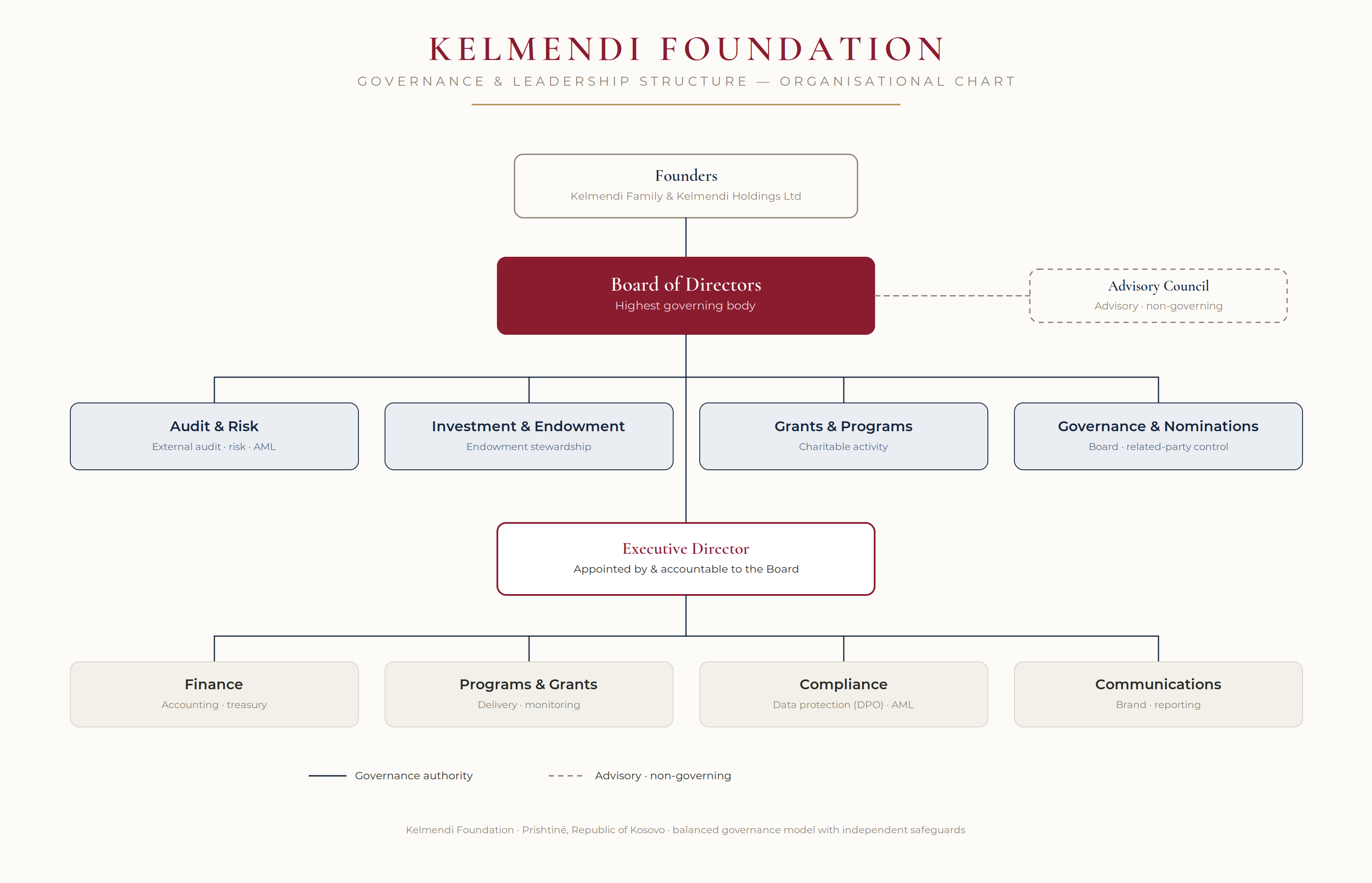
A balanced model of governance with independent safeguards — Founders’ reserved powers, an independent Board, four committees, professional management and an Advisory Council.
The Foundation is an independent, non-profit, public-benefit philanthropic and endowment institution established under the laws of the Republic of Kosovo. As an asset-based foundation it has no members; its Board of Directors — not a general assembly — is its highest governing body.
Assets and activities serve the charitable mission and the public interest, not private interest.
The Foundation acts autonomously, with independent voices in meaningful positions of oversight.
Every office operates within a clear mandate and is answerable for its decisions.
Governance, finances and material decisions are documented and, where appropriate, disclosed.
Conflicts of interest are disclosed and managed openly, in recognition of the Founders’ wider business interests.
The endowment is managed prudently to preserve its long-term capacity to serve the mission.
Authority flows downward from the Founders’ reserved powers, through the Board and its committees, to the executive leadership responsible for day-to-day operations.
Kelmendi Family & Kelmendi Holdings Ltd
Hold reserved constitutional powers only — they do not manage day-to-day affairs.
The highest governing body
Sets strategy and exercises ultimate oversight of assets, integrity and performance.
Audit & Risk · Investment & Endowment · Grants & Programs · Governance & Nominations
Standing committees that advise and prepare matters; authority remains with the Board.
Appointed by and accountable to the Board
Run operations, staff and budget within delegated authority.
Sits alongside the Board
Provides counsel and credibility, without legal governance authority.
The Founders establish the Foundation, define its mission and endow its initial assets. To protect its independence and public-benefit character, they do not manage its affairs; their influence is exercised through a defined set of reserved powers recorded in the Founding Charter. All powers not expressly reserved vest in the Board.
The Founders
The Board holds ultimate responsibility for the Foundation’s strategy, assets, integrity and performance. It is led by an independent Chair who holds no executive authority; the offices of Chair and Executive Director are held by different persons, keeping governance and management distinct.
Initially five members, expandable to seven as activities grow.
No fewer than one-third independent, moving toward parity over time.
Founder-nominated members safeguard mission; independents strengthen oversight.
A conflicted director is recused and excluded from quorum on that matter.
Each committee operates under written terms of reference approved by the Board, is chaired by a director, and reports to the Board. Committees advise and prepare matters; ultimate authority remains with the Board unless expressly delegated.
Independent oversight of financial integrity, risk and compliance — financial reporting, the external audit, internal controls, and anti-money-laundering obligations.
Prudent stewardship of the endowment — the investment policy and asset allocation, the annual spending rule, and investment performance, custody and financial risk.
Oversight of charitable activity and impact — grant-making policy and criteria, significant proposals, and the monitoring, evaluation and impact reporting of funded work.
Board composition, succession and related-party oversight — independence and succession planning, annual conflict declarations, and related-party transactions.
The Executive Director is the Foundation’s chief executive, appointed by and accountable to the Board, and may attend Board meetings as a non-voting participant. A secretariat supports delivery across four core functions.
A designated Data Protection Officer and an anti-money-laundering officer report to the Executive Director with a direct line of escalation to the Audit & Risk Committee.
The Advisory Council is a non-governing body of distinguished individuals who lend the Foundation strategic counsel, technical expertise, networks and credibility. It sits alongside the Board and holds no legal governance authority: it does not direct the Foundation, approve expenditure or bind the institution.
The Founders control operating companies across many sectors, so the Foundation may transact with connected parties. This is governed openly rather than avoided. A written Related-Party Transactions Policy requires prompt disclosure, arm’s-length terms, full documentation, independent approval above a defined threshold with the conflicted person recused, annual declarations of interest, and disclosure of material dealings in the annual report.
Financial statements are independently audited, overseen by the Audit & Risk Committee.
An annual report covers activities, governance and finances, filed with the competent Kosovo authorities.
Decisions of the Board and its committees are minuted and retained.
A confidential channel for reporting concerns, in line with the Law on the Protection of Whistleblowers.
This page sets out a governance framework and does not constitute legal advice. Statutory references and any conditions relating to Public Beneficiary Status are verified against the consolidated legislation of the Republic of Kosovo and reviewed by qualified counsel. Where this framework and the Founding Charter differ, the Founding Charter prevails.